

 2026-05-18
 126
In 2026, global capital markets are increasingly diverging: Hong Kong's IPO market is exploding against the trend, with first‑quarter fundraising exceeding HK$100 billion, yet the Hang Seng Tech Index once fell over 15%; the Straits Times Index (STI) broke through the 5,000‑point historical milestone, demonstrating defensive resilience. The score gap between the two financial centres is only 1 point, indicating the most intense stage of competition. Based on the latest data up to May 2026, this article provides a comparative analysis across market performance, IPO ecosystem, liquidity, and industry suitability, offering a decision‑making framework for IPO companies choosing their listing venue.
I
Year‑to‑Date Market Performance in 2026
(I) Singapore Market: Breaking 5,000 Points with Consecutive Net Institutional Inflows
On 12 February 2026, the STI hit 5,000 points intraday, closing at 5,016.76, a record high. In Q1, the STI rose 5.1%, with a total return of 5.6%, outperforming the FTSE Asia Pacific Index (0.4%) and the FTSE Global Index (-3.0%). As of early May, the STI is consolidating around 5,000, with the healthcare and technology sectors trading at about 40x P/E, and the overall market at about 15x.
Fund flows: Institutional money has recorded net inflows for 12 consecutive months, totalling over S$450 million; SME turnover surged 135% month‑on‑month in February. The government's EQDP programme was expanded to S$6.5 billion (initial S$5 billion + S$1.5 billion from the 2026 budget), designating nine fund managers to support the market.
The REITs sector fell 6.4% in Q1 due to Middle East conflicts, but rebounded over 5% in Q2, with solid fundamentals.
(II) Hong Kong Market: Contrasting Pressures on Indices and IPO Explosion
Secondary market: The Hang Seng Index fell 3.29% in Q1, while the Hang Seng Tech Index tumbled 15.70%, significantly underperforming the Nasdaq (-7.11%). However, average daily turnover still exceeded HK$200 billion (HK$210.9 billion in January, HK$226.2 billion in March). As of 11 May, the Hang Seng Tech Index P/E was about 22‑23x, at the 32nd percentile historically, indicating attractive valuation.
Primary market: There were 40 IPOs in Q1, raising HK$110.163 billion, a year‑on‑year surge of 490%, ranking first globally. The A+H listing wave continues (Muyuan Foods, Dongpeng Beverage, etc.), and 18C hard‑tech companies are landing densely (Zhipu, Biren Technology, etc.). In January alone, IPO fundraising reached HK$39.3 billion, up 555% year‑on‑year.
Southbound funds: Net purchases in Q1 were less than HK$100 billion (compared with over HK$150 billion in the same period last year), and on 1 April there was a net outflow of HK$12.7 billion. As of 8 May, cumulative net inflow via Stock Connect reached HK$5.38 trillion, accounting for about 20.8% of Hong Kong’s average daily turnover, slightly down from 23.4% for the full year 2025.
(III) Global Financial Centres Ranking: Unprecedented Close Competition
According to the 39th Global Financial Centres Index published in March 2026, the top ten financial centres are: New York, London, Hong Kong, Singapore, San Francisco, Shanghai, Dubai, Seoul, Shenzhen, Tokyo. Most notably, the score gap among the top four – New York, London, Hong Kong, Singapore – is only 1 point, the tightest top‑4 race since the index was first launched in 2007. In sub‑indicators, Hong Kong ranks first globally in "Banking" and "Financing", maintains top place in "Insurance", and rose to second in "Investment Management". This ranking pattern confirms that the Hong Kong‑Singapore rivalry has entered a new phase of refined co‑opetition, with more distinct strategic positioning rather than direct homogeneous competition.
II
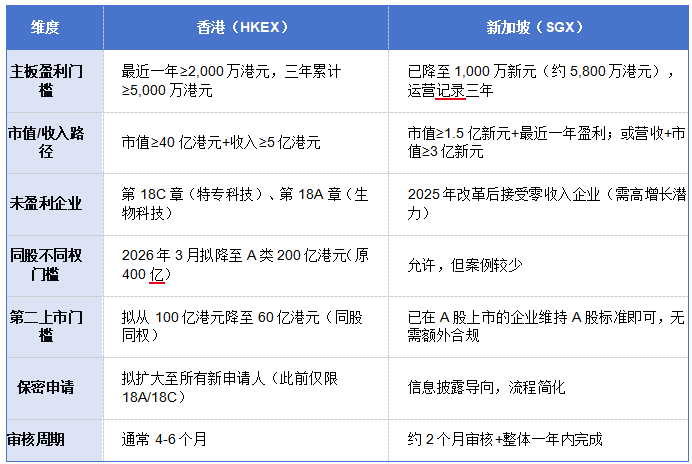
Comparison of Listing Regimes and Entry
Thresholds (Latest 2026)
III
Liquidity and Refinancing Activity Comparison
(I) Hong Kong's Dual Liquidity Engines
In 2026, Hong Kong's liquidity sources are supported by two core forces: on the domestic side, southbound funds remain in a net inflow channel, with cumulative net purchases exceeding HK$150 billion year‑to‑date (as of end‑February); on the foreign side, international institutional shareholding remains high, and some European and US capital has accelerated its return as Chinese assets enter historically low valuation zones. Average daily turnover remains above HK$200 billion, still among the top global markets despite a slight year‑on‑year decline.
In refinancing, Hong Kong has demonstrated extremely efficient fundraising capabilities. After raising about HK$41 billion in its 2025 IPO, CATL raised another HK$39.1 billion (about US$5 billion) through a placing in Hong Kong in April 2026, with over 150 institutions participating; it issued about 62.38 million shares at HK$628.20 per share.
For the full year 2025, secondary fundraising by Hong Kong‑listed companies (placings, rights issues, etc.) approached HK$361.9 billion, far exceeding total IPO proceeds. Since the start of 2026, 29 Hong Kong companies have conducted placings, raising nearly HK$26.3 billion, far exceeding the HK$1.07 billion in the same period of 2025. These figures show that Hong Kong has formed a mature financing ecosystem driven by both IPOs and subsequent refinancing, enabling companies to tap into strong ongoing fundraising capabilities after listing.
(II) Improving Liquidity at SGX
Singapore has also recorded substantial liquidity improvements in 2026. SME turnover surged 135% month‑on‑month in February, with net institutional inflows for 12 consecutive months totalling over S$450 million. On the funding side, retail investor participation has further warmed, partly absorbing selling pressure from institutions during volatile periods, providing two‑way support.
Under the EQDP mechanism, the nine selected funds are legally required to participate in new share placements and provide additional capital to the market, further improving post‑IPO liquidity. However, compared with Hong Kong's daily turnover of over HK$200 billion (more than S$34 billion/day), SGX's liquidity depth still lags considerably.
IV
Industry Suitability and Differentiated Advantages
(I) Hong Kong: A+H Leaders + AIGC Unicorns + Large‑Cap US‑Listed Chinese Stock Returnees
A structural highlight of Hong Kong's Q1 2026 IPOs is the A+H listing wave. A number of industry leaders, including Muyuan Foods (raising over HK$10 billion) and Dongpeng Beverage, have successfully listed in Hong Kong. At the same time, AI unicorns such as Zhipu, MiniMax, Huayan Robotics, and Kaileshi Technology have densely landed on the Hong Kong market under the 18C regime. In the semiconductor sector, Biren Technology soared 75% on its first day, with market cap exceeding HK$82.6 billion, becoming Hong Kong's first GPU stock.
On the global front, Shein is targeting a US$30 billion valuation for its Hong Kong IPO; logistics firm GLP, registered in Singapore, is also considering a Hong Kong listing with a US$20 billion valuation; data centre operator DayOne is targeting a US$20 billion valuation for its US IPO. This shows that HKEX has established itself as the "first stop" for mega‑IPOs, naturally becoming the ideal overseas platform for leading tech companies and A‑share leaders.
(II) Singapore: Stable REITs, Fintech Expansion, and Specialisation in Secondary Listings
Amid global geopolitical conflicts and macro concerns in Q1 2026, S‑REITs fell about 8% in Q1 but rebounded over 5% in Q2. Hospitality REITs recorded steady dividend growth, with CapitaLand Ascott Trust reporting positive per‑unit income growth during its 20th anniversary financial report, reinforcing long‑term investor confidence. REITs remain SGX's most attractive sector, with large REIT issuances also contributing to Q1 IPO volumes.
On the other hand, ahead of the SGX‑Nasdaq dual‑listing framework's mid‑year launch, many Southeast Asian tech companies have expressed strong interest. Singapore also offers A‑share companies a differentiated channel for “secondary listing + international capital access,” making it an important choice for many mid‑sized A‑share listed companies to build an international capital structure beyond their home market.
V
Latest Policy Reforms in
Hong Kong and Singapore (2026)
(I) Hong Kong's Significant Listing Regime Optimisation (March 2026)
In March 2026, the Hong Kong Stock Exchange published a consultation paper outlining three major directions for significantly improving the listing regime:
First, substantially lowering the threshold for Weighted Voting Rights (WVR) structures. The Class A market cap threshold is reduced from HK$40 billion to HK$20 billion; the Class B threshold from HK$10 billion to HK$6 billion, with the revenue threshold lowered from HK$1 billion to HK$600 million; the voting rights differential ratio cap may be relaxed to 20x. Second, significantly reducing the threshold for secondary listings by overseas issuers. The market cap requirement for issuers with equal voting rights is lowered from HK$10 billion to HK$6 billion, aligning with WVR issuers, facilitating the return or secondary choice of more overseas‑listed Chinese stocks and Southeast Asian companies. Third, fully opening up confidential IPO applications. Previously only available to 18A biotech, 18C specialist tech, and a few exempted companies, the proposal now extends to all new applicants, substantially reducing pre‑IPO uncertainty and business exposure risk. In addition, the Exchange plans to refine the definition of "innovative industry companies", dividing them into "technology track" and "business model track", and automatically recognising all qualified biotech and specialist tech companies (even if not listed under 18A or 18C) as "innovative industry" companies without needing individual proof.
The consultation period ended on 8 May 2026, and reforms are expected to be implemented in phases after summarising feedback, further cementing Hong Kong's position as the preferred fundraising venue for growth enterprises.
(II) Singapore's Ongoing Improvements
SGX already significantly lowered its mainboard profit threshold to S$10 million and accepted zero‑revenue companies at the end of 2025, shifting to a disclosure‑based regulatory framework. In 2026, it has further strengthened: the secondary listing path is further simplified, allowing A‑share‑compliant firms to list on SGX without additional requirements; the EQDP fund pool was increased to S$6.5 billion; the SME listing environment continues to improve, with the entire process from initiation to completion taking about a year, and SGX review time within two months. In addition, in February 2026, Yicai reported that SME turnover surged 135% month‑on‑month, institutional inflows remained strong, and the policy backstop effect is becoming visible.
VI
Illustrative Cases
1. CATL (Hong Kong refinancing): Raised HK$41 billion in 2025 IPO, then a further HK$39.1 billion via placing in April 2026, totalling HK$80 billion – validating Hong Kong's dual‑engine capability of "IPO + continuous refinancing".
2. Biren Technology (HKEX 18C): Listed on 2 January 2026, surged 75% on debut, market cap exceeded HK$82.6 billion, becoming Hong Kong's first GPU stock.
3. Muyuan Foods / Dongpeng Beverage (A+H): Completed billion‑dollar listings in Q1 2026, as mainland leaders use Hong Kong to access international capital.
4. China Medical System (SGX secondary listing): After its introduction listing in 2025, it has remained active, and the SGX healthcare sector valuation rose to about 40x P/E.
5. Several A‑share companies queuing for SGX secondary listings: As of March 2026, about five Chinese companies were in the SGX review pipeline.
VII
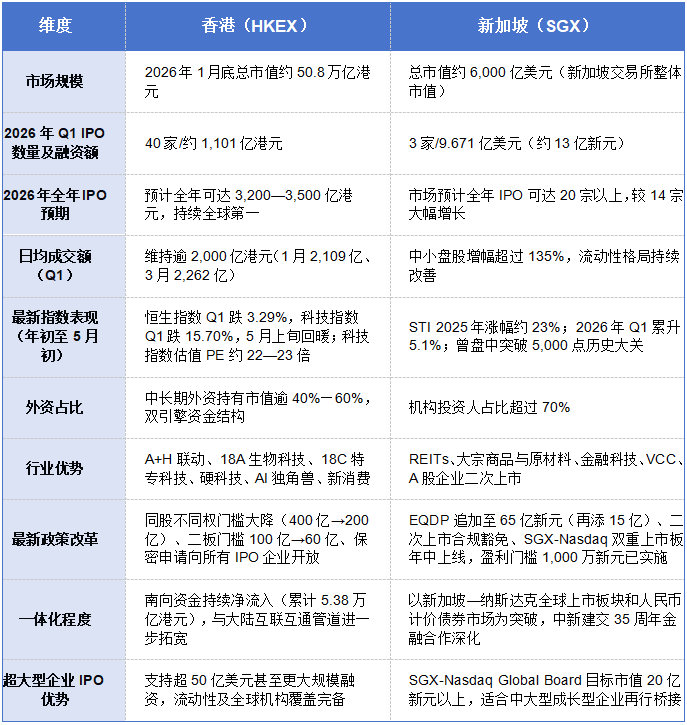
2026 Comparative Summary Table
VIII
IPO Venue Selection Guide
(2026 Updated)
(I) Prefer Hong Kong When:
1. The business is rooted in the mainland China market and seeks dual attention from mainland and global investors. As long as the core operation is in mainland China, the depth of Hong Kong's capital window remains irreplaceable; the fact that over 40 companies listed in Hong Kong in 2026 proves that both the A+H model and the new economy framework are mature.
2. The single fundraising scale exceeds US$500 million, or the target valuation exceeds US$5 billion for ultra‑large enterprises. For example, DayOne (target US$20 billion valuation) chose the US over SGX for its IPO; GLP (target US$20 billion) prefers Hong Kong. This shows that ultra‑large IPOs inherently require the depth and coverage provided by Hong Kong and US markets.
3. The company is in hard tech, AI unicorn, biotech, new consumer, new energy, etc., and wants to connect quickly with mainstream international institutional investors.
4. The business spans multiple countries but relies on China's core supply chain: after IPO, the company needs flexible and sustained access to capital from China and international institutions; Hong Kong's refinancing cases (e.g., CATL's total HK$80 billion fundraising) demonstrate strong aftermarket financial capability.
5. Already listed in the US and need a hedge against US‑listed Chinese stock risks, a second home market, or a return listing.
(II) Prefer Singapore When:
1. Southeast Asia is the core business region, or the headquarters is in ASEAN and actively expanding globally. Against the backdrop of deepening Guangdong‑Singapore capital ties, Singapore's refinancing and regional project mobility are particularly attractive.
2. The enterprise is in REITs, commodities, digital remittance (Fintech), VCC fund structures, or seeks global risk‑balanced valuations in biotech and medical devices. Singapore's healthcare sector trades at about 40x P/E, above the overall market.
3. Small‑to‑mid‑cap seeking long‑term stable locked‑up funds: SGX's over 70% institutional ownership provides equity stability, with shorter secondary or mainboard listing cycles and review times within about two months.
4. Already listed on A‑share and plans to balance offshore investor structure while gaining international capital market identity. SGX's secondary listing exemptions are attracting many Chinese companies, especially small‑to‑mid‑sized tech and manufacturing leaders from Zhejiang.
(III) The Best Path: "Dual Listing" or "HK then SG"
For leading Chinese tech enterprises with operations spanning mainland China and ASEAN, an increasingly popular path is: first complete the main IPO in Hong Kong, and then, based on actual business expansion into Singapore and other regions, complete a secondary listing on SGX via introduction within the second fiscal year, achieving full coverage of both international capital markets. The launch of the SGX‑Nasdaq global board in 2026 further reduces the capital and time costs of dual listings, making the "dual‑home" strategy a true market mainstream.
The capital market landscape in 2026 has become clearer: the complementary model of “scale in Hong Kong, growth in Singapore” is taking shape. Hong Kong establishes its irreplaceable first place through liquidity, refinancing, and mega‑IPO capacity; Singapore differentiates itself with low‑compliance‑cost secondary listing mechanisms, the REITs financial instrument, and a bridge to Nasdaq. The 1‑point gap in the financial centres ranking shows that international capital increasingly embraces a diversified allocation model of “One China (Hong Kong) + Singapore (two‑way Asian capital services).
When deciding on a listing venue, companies should return to the essence of their business – not simply choosing which exchange is "better," but which can provide the most matching capital services for their business growth. With the mid‑2026 launch of the SGX‑Nasdaq global board and the HKEX WVR threshold reform, "more diverse, lower cost, and more flexible" are becoming the keywords for Asian capital markets. For high‑quality growth‑oriented tech companies, the optimal future solution is no longer "either/or," but to leverage mechanism optimisation and connectivity dividends to achieve a superimposed capital market effect through dual or multiple listings.


 Official WeChat
 Official WeChat
